Best Position Sensor Types for Accurate Measurement Solutions?
In the realm of automation and precision engineering, Position Sensors play a vital role. They are crucial in providing accurate measurements that drive successful outcomes in various applications. Dr. Emily Chen, a leading expert in sensor technology, once remarked, "Position sensors are the backbone of modern control systems." This highlights their essential function.
Different types of position sensors exist, each with unique advantages. Some are designed for high precision, while others are more suited to rough environments. Take the potentiometer, for instance. It’s simple yet effective. However, when precision is key, more sophisticated sensors are needed. Reflecting on this, it's clear that selecting the right position sensor often presents a challenge.
Despite advancements, achieving absolute accuracy remains elusive. Factors like environmental conditions can create discrepancies in measurements. Further, user understanding of the technology varies. This uncertainty can lead to misapplication of position sensors. Addressing these issues is essential for optimizing their potential in industry and research.
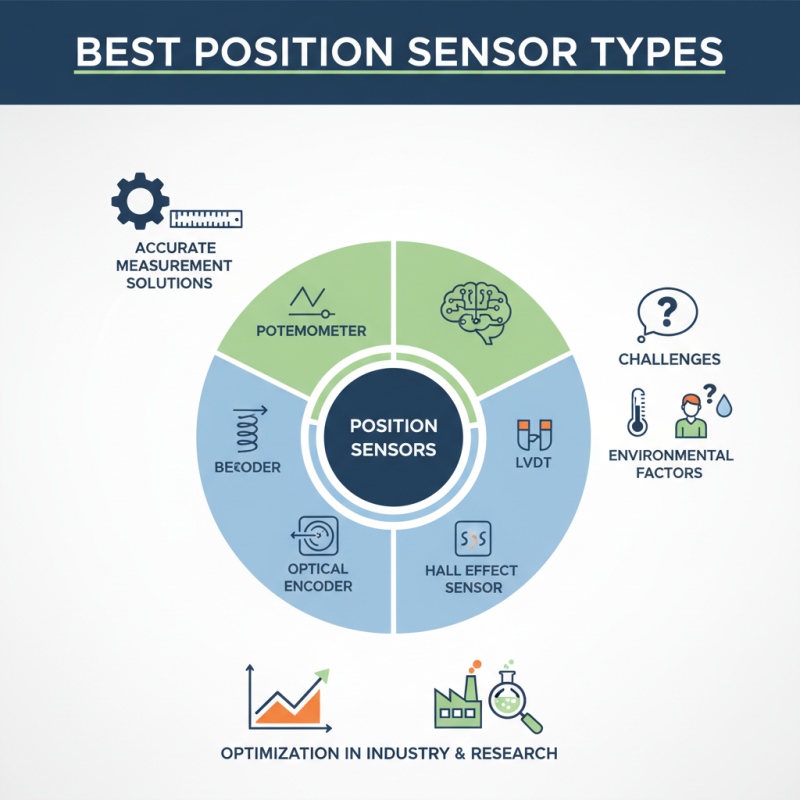
Types of Position Sensors: Overview of Key Variants and Their Uses
Position sensors play a critical role in various applications. They help determine the location of an object in space. Several types exist, each suited for specific tasks. Some popular variants include potentiometers, linear variable differential transformers (LVDTs), and capacitive sensors.
Potentiometers are simple and cost-effective. They measure position by adjusting resistance. However, they can wear out quickly. This limits their lifespan and reliability. LVDTs offer higher precision. They provide accurate readings without direct contact, which enhances durability. Capacitive sensors are sensitive yet versatile. They work well in various environments but may require calibration for optimal performance.
**Tips:**
When choosing a position sensor, consider the application’s demands. Look at factors like range, environment, and precision. Sometimes, a simple sensor suffices. Understand that more complexity can lead to challenges, such as increased cost or maintenance.
In practical scenarios, no sensor is perfect. Issues may arise due to environmental factors. Temperature changes can affect readings. Calibration is essential for maintaining accuracy. Think critically about the chosen sensor type. Ensure it aligns with the specific operational needs you've identified.
Best Position Sensor Types for Accurate Measurement Solutions
| Sensor Type | Working Principle | Typical Applications | Advantages |
| Potentiometric Sensors | Variable resistance based on position | Robotics, industrial machinery | Low cost, simple design |
| Magnetic Sensors | Detects magnetic fields to determine position | Automotive, consumer electronics | Durable, resistant to dust and moisture |
| Optical Sensors | Uses light to determine position | Medical devices, automation | High accuracy, non-contact measurement |
| Ultrasonic Sensors | Measures distance using sound waves | Level measurement, robotics | Wide measurement range, safe |
| Inductive Sensors | Detects metal objects via electromagnetic field | Position detection in manufacturing | Robust, no contact wear |
Applications of Position Sensors in Industrial Automation and Robotics
Position sensors play a vital role in industrial automation and robotics. These devices measure the position of objects accurately. They can detect linear or rotational movement. In robotics, they help ensure precise control of joints and limbs. For example, a robot arm needs to know its exact position to perform tasks effectively. Without accurate sensing, errors can lead to inefficiencies or even accidents.
In industrial settings, position sensors enhance the efficiency of automation processes. They monitor conveyor belts, which track the position of goods. If a belt misaligns, sensors can trigger adjustments quickly. This can prevent costly downtime. Furthermore, in assembly lines, knowing the exact position of parts is crucial. Sensors facilitate smooth operations by providing real-time feedback.
However, challenges remain in integrating these sensors into existing systems. Compatibility issues can arise. Some environments may expose sensors to harsh conditions, affecting performance. Additionally, maintenance is sometimes overlooked, leading to sensor failure. Addressing these problems requires careful planning and regular assessments. Finding the right balance between technology and practicality is essential.
Accuracy Metrics: Assessing Precision in Position Sensor Measurements
When selecting position sensors, accuracy is paramount. Various metrics determine the precision of measurements. Resolution is one such metric. Higher resolution means smaller incremental changes can be detected. This is vital in applications like robotics and automation. Yet, too high resolution can introduce noise. Balancing these factors is tricky.
Another important aspect is linearity. It measures how closely the output follows the actual position. Non-linear responses can lead to significant errors. Many sensors struggle with this. Calibration can help, but it adds complexity. The environment also plays a role. Temperature or electromagnetic interference can affect readings.
Finally, repeatability matters. This indicates if sensors provide the same output under identical conditions. Inconsistent results can harm system reliability. It is essential to routinely check and validate sensor performance over time. Position sensors need ongoing assessment to ensure they meet accuracy requirements.
Emerging Technologies: Innovations in Position Sensor Design and Functionality
Emerging technologies are transforming position sensor design and functionality. Recent reports indicate that the global position sensor market is projected to grow by over 6% annually, reaching approximately $4 billion by 2026. This growth stems from the rise of smart manufacturing and automation technologies. Industries are adopting advanced sensors to enhance accuracy and responsiveness.
Innovations in sensor materials and designs are noteworthy. For instance, the use of MEMS (Micro-Electro-Mechanical Systems) technology has led to smaller and more precise sensors. These devices can measure position in real-time with minimal error margins. However, integration can be a challenge. Not all systems are equipped to handle the data output from advanced sensors.
Wireless technology is also gaining traction. Wireless sensors offer flexibility and ease of installation, but they can face signal issues in complex environments. Additionally, power consumption can be a concern. While battery-operated systems reduce wiring, they also require more maintenance. Balancing these factors is crucial for effective implementation in various applications.
Market Trends and Future Predictions for Position Sensor Development
The position sensor market is rapidly evolving. According to a recent industry report, the global position sensor market is expected to grow at a CAGR of 7% from 2023 to 2028. This growth is driven by the increasing demand for automation and control in various industries. Many sectors, including manufacturing and automotive, are adopting advanced position sensing technologies.
Current trends showcase a shift toward contactless sensors. These devices reduce wear and tear, prolonging lifespan. However, the complexity of these sensors can lead to integration challenges. Many engineers report difficulties in aligning new systems with existing infrastructure. Furthermore, while emerging technologies like MEMS sensors show promise, they still face reliability issues. The future of position sensors hinges on achieving greater accuracy and robust data processing capabilities.
The demand for miniaturized sensors is also rising. These smaller devices provide flexibility in design but can pose challenges in calibration. As systems become more compact, achieving precise measurements becomes increasingly critical. Industry forecasts indicate that the need for high-performance sensors will continue to rise, with applications in robotics and IoT driving innovation. The balance between sensor compatibility and accuracy will be essential for future advancements.
Best Position Sensor Types for Accurate Measurement Solutions